
Certainly! Here is a structured discussion of human-AI collaboration, including its key concepts, benefits, challenges, and future implications.
How acceptable would it be if this article had been written entirely by artificial intelligence (AI), but under the direction of a human? Would your answer differ if it were an academic publication, a university assignment, a business report, or a marketing campaign?
Although these questions may initially appear rhetorical, they illustrate how judgments about human–AI collaboration can change according to the purpose of the creative work and how humans and AI participate in it.
As AI assumes increasingly sophisticated roles in creative work, broad descriptions such as AI-assisted, AI-generated, and human–AI collaboration can encompass substantially different forms of participation. AI may provide occasional suggestions, generate substantial portions of a project, or determine the direction of the work.
This raises more fundamental questions: How is creative work distributed between humans and AI, and how can these distributions be distinguished? More specifically, what is delegated to AI, what remains primarily human, and how are their respective contributions organized in creative work?
Emerging technologies often follow a hype cycle, moving from inflated expectations toward a more realistic understanding of their capabilities and limitations. Generative AI appears to be following a similar trajectory: after an initial period of enthusiasm surrounding its potential, researchers are increasingly examining both the opportunities and challenges of human–AI collaboration.
The consequences of this collaboration appear to depend partly on how individuals rely on AI in relation to their own reasoning. For example, recent research suggests that generative AI can function as a third cognitive system alongside intuitive (System 1) and deliberative (System 2) thinking. Across three experiments, the researchers found that participants frequently deferred to AI recommendations, improving their performance when AI was accurate but undermining it when AI was incorrect, a phenomenon they termed cognitive surrender.
A related concern involves an effort-reward mismatch. While human learning and understanding require cognitive effort, generative AI allows individuals to synthesize, evaluate, and articulate information with comparatively little intellectual engagement. Although this can increase efficiency, it may also allow individuals to obtain the results of intellectual work without participating in the processes through which understanding develops.
At the same time, creative work has long been distributed across people, tools, and environments. Generative AI belongs to a long history of technologies that extend human activity, from writing and calculators to search engines and the internet. What distinguishes it is the growing range of functions it can perform, including generating ideas and creative outputs, evaluating alternatives, proposing directions, and coordinating activities.
These capabilities raise new questions about how creative work is distributed between humans and AI, and how different configurations of participation may serve different contexts and purposes. But an important challenge remains: how can we distinguish between different distributions of human–AI participation in creative work?
To address this challenge, Professor Todd Lubart and I have proposed the Human–AI Participation Map (HAIP-Map): a framework for mapping human–AI collaboration according to the distribution of creative work between humans and AI across two complementary dimensions: Leading and Making.
Leading concerns who primarily guides the creative process, from humans to AI. This includes framing problems, establishing intentions, making important decisions, evaluating alternatives, and determining the overall direction of the work.
Making concerns who primarily performs the work through which creative outcomes are generated, from humans to AI. This includes developing ideas, constructing arguments, writing text, generating images, or developing software.
Importantly, Leading and Making should be understood as flexible dimensions rather than rigid categories. The distinction depends on the role an activity plays within a particular creative process rather than on the activity itself. For instance, generating ideas may contribute to Making when producing alternatives within an established direction, but also to Leading when those ideas redirect the course of the work. Similarly, evaluating an idea may involve assessing an outcome against established criteria or reconsidering the criteria themselves. In other words, the same activity may contribute to both dimensions, depending on its role in the creative process.
Although the HAIP-Map brings these dimensions together, Leading and Making have long been distributed among different people, tools, and materials involved in creative work. For example, in some design studios, an art director establishes the initial direction, junior designers develop a prototype, senior designers review and redirect the work, and junior designers subsequently refine and finalize it. Similar arrangements can be traced back to Renaissance workshops and artists’ ateliers, where masters directed creative work that was partly carried out by apprentices and assistants.
By combining these two dimensions, we can map different forms of human–AI collaboration according to how much of the Leading and Making is performed by humans or delegated to AI.
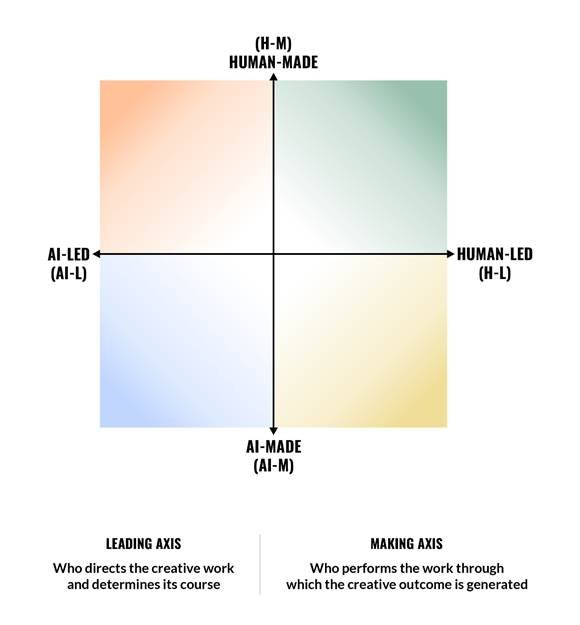
The map represents a continuous space rather than four fixed categories. Positions within it can also change throughout an activity: a human–AI collaboration may trace a trajectory across the map as Leading and Making shift between participants at different moments of the creative process.
For instance, consider the task of writing this article:
- H-L/H-M: I develop its arguments and write the article without any generative AI assistance.
- H-L/AI-M: I develop the arguments and structure while delegating much of the writing to AI.
- AI-L/H-M: I write the article myself while following arguments and a structure proposed by AI.
- AI-L/AI-M: I delegate both the development of the arguments and the writing of the article to AI.
These examples represent the four extremes of the map. In practice, most collaborations fall somewhere between them, and their positions can change as the work develops.
This brings us back to the question that opened this article. The HAIP-Map suggests that asking whether AI was used provides only a partial picture of human–AI collaboration. Instead of treating AI use as a simple yes-or-no question, we can ask more informative questions: How was the work distributed? Who led it? Who made it? And what forms of human participation mattered for the purpose of the activity? In short, similar descriptions of AI-assisted or AI-generated work can mean substantially different things.
This distinction is particularly important in education, where participation in creative work can itself be part of the learning process. The question is therefore not how to keep students as close as possible to the H-L/H-M position, but how different positions on the map relate to what we want students to learn.
What matters is whether the work being delegated to AI is also the work through which learning is expected to occur. When activities such as critical thinking, problem framing, and evaluating alternatives are central to the intended learning, delegating them to AI may prevent students from developing the very skills the activity is designed to cultivate.
For example, if an assignment aims to teach students how to develop arguments, delegating that task to AI might defeat the purpose. But if the objective is to teach students how to critically evaluate arguments, working with AI-generated examples might be entirely appropriate.
Conversely, AI participation does not necessarily undermine learning when students retain and can demonstrate authorship and agency throughout the collaborative process, critically engaging with AI contributions and directing how the work develops.
As research on AI and creativity advances, understanding how creative work is distributed between humans and AI may become increasingly important. The HAIP-Map offers a starting point for examining these different forms of participation. In our academic chapter, we also explore how the framework might be applied in practice, particularly in academic research and writing.
Creative work has always been distributed across people, tools, technologies, and environments. Although the HAIP-Map focuses specifically on human–AI collaboration, its underlying questions extend beyond AI: Who directs creative work, who performs it, and how do these contributions shape what becomes possible?
Generative AI makes these dynamics particularly visible because artificial systems are becoming increasingly capable of participating in both dimensions of creative work. As these capabilities continue to expand, the challenge may no longer be determining what machines can do but considering how humans choose to participate in creative work as the systems around them change.
—
This article was adapted from the forthcoming academic chapter:
Zamana, F. & Lubart, T. (forthcoming). Who leads, who makes? Mapping human–AI participation in creative work. In Wegerif, R., Casebourne, I. & Ness, I. (Eds.) Handbook of AI and the Future of Education. Springer.